
PD Avengers Challenges Federal Council: Who’s Responsible, What’s the Deadline, and Did It Work?
PD Avengers was among 15 nonprofit organizations invited to address the Advisory Council on Parkinson’s Research, Care, and Services, calling for measurable action, better care, prevention and accountability as the United States develops its National Plan to End Parkinson’s.
PD Avengers brought a straightforward message to the U.S. Advisory Council on Parkinson’s Research, Care, and Services (ACPRCS) on August 24: the National Plan to End Parkinson’s must ultimately be judged by what it changes.
During the Council’s public meeting, PD Avengers joined 14 other nonprofit organizations presenting their priorities and recommendations for the National Plan.
For PD Avengers, the test is simple:
Are fewer people developing Parkinson’s?
Are people living with Parkinson’s getting better care?
Is research moving faster?
Those are the outcomes that should determine whether the National Plan is succeeding.
Three priorities for action
PD Avengers identified three areas that should be at the centre of the National Plan.
First, everyone living with Parkinson’s should have access to reliable, high-quality care regardless of where they live, their insurance coverage or their income.
Second, the United States should work to prevent Parkinson’s where possible, including taking action on environmental and occupational risks while continuing to strengthen the science.
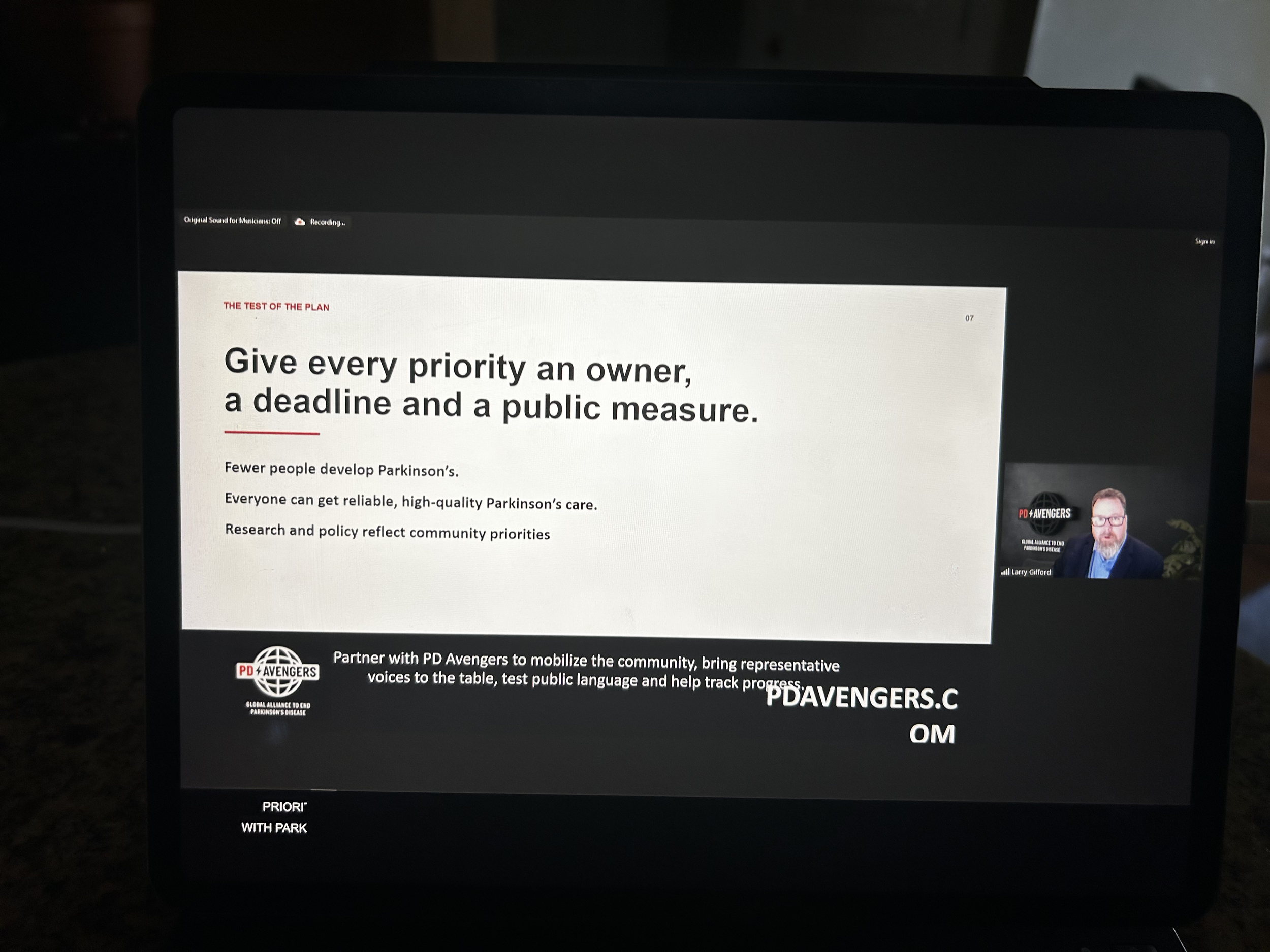
Third, major commitments in the National Plan should come with clear responsibility, adequate funding, deadlines and public measures of progress.
As PD Avengers told the Council:
“A goal without resources is just a wish.”
From appointments to better outcomes
PD Avengers also called for changes in how Parkinson’s care is measured and paid for.
Instead of simply measuring visits and services, the organization urged Medicare and Medicaid to help define and test comprehensive Parkinson’s care based on outcomes that matter in everyday life — including access to rehabilitation and specialists, treatment of non-motor symptoms, receiving Parkinson’s medications on time while in hospital, maintaining independence and quality of life.
The goal: pay for good Parkinson’s care, not simply a series of appointments.
Making prevention part of the National Plan
PD Avengers also proposed a national Parkinson’s prevention effort focused on environmental and occupational risks.
Research, environmental regulation, workplace protections, veterans’ health, surveillance and public-health data currently sit across multiple agencies and levels of government. PD Avengers called for those pieces to be connected so evidence about preventable risks can more readily lead to action.
The organization emphasized that policy should follow the best available evidence, with actions matched to the level of risk and updated as the science develops.
More than 400 responses to National Plan consultation
The August 24 meeting came shortly after the close of the federal Request for Information seeking input on the National Plan.
The National Institute of Neurological Disorders and Stroke (NINDS) reported that more than 400 responses were submitted. Because the consultation closed recently, a detailed analysis was not yet available, but NINDS said additional information will be shared as the responses are reviewed.
The Council also heard an overview of 187 public comments submitted to date, including 25 received since its previous meeting, as well as live comments from members of the Parkinson’s community.
Tracking what government is already doing
NINDS also updated the Council on work to create an inventory of federal Parkinson’s research, care and services programs.
The effort is intended to help the Council understand what programs already exist, identify gaps and eventually provide a clearer picture of federal investments in Parkinson’s over time.
That work closely connects with another PD Avengers recommendation: create a simple, public scorecard showing what government has committed to do, who is responsible, the deadline, whether the work has been funded and whether progress is on track.
The Parkinson’s community must be part of the process
PD Avengers also stressed that people with Parkinson’s and care partners should not simply be consulted after major decisions have been made.
They should be partners in determining what good care looks like, which outcomes should be measured and how progress should be judged.
Participation also needs to extend beyond the people and organizations already accustomed to being in these rooms. That means reducing barriers through compensation, translation, accessible technology, rural outreach and flexible ways to participate.
What happens next
The Council’s Research and Regulatory Programs Subcommittee and Care, Services, and Supports Subcommittee reported on their initial work during the meeting, including development of an organizing framework centred on the patient journey.
The next ACPRCS public meeting is scheduled for November 9, 2026, with an expected focus on public-private partnerships and cross-sector collaboration.
Meeting recordings, presentations, public comments and related materials are expected to be posted on the ACPRCS website in the coming weeks.
PD Avengers has offered to help mobilize the Parkinson’s community, bring more diverse voices into the process, gather community priorities, test public-facing language and help track progress.
Because ultimately, as PD Avengers told the Council:
“The Plan will not be judged by what it says. It will be judged by what it changes.”
