

Carly Simon Reveals She Is Living with Parkinson’s: “I Am Still Very Much Here”
The legendary singer-songwriter has spoken candidly about declining mobility, fatigue, anxiety, depression and apathy—and how making music has helped her continue moving forward.
Singer-songwriter Carly Simon has publicly revealed that she is living with Parkinson’s disease, ending a period of relative silence with a deeply personal account of changes to her movement, energy, motivation and emotional health.
Simon, 83, said she needed time to understand the diagnosis, adjust to its effects and decide how much she was prepared to share publicly. Her disclosure also explains why she has largely remained outside the public eye in recent years.
Although Parkinson’s has changed the rhythm of her life, Simon made one point unmistakably clear:
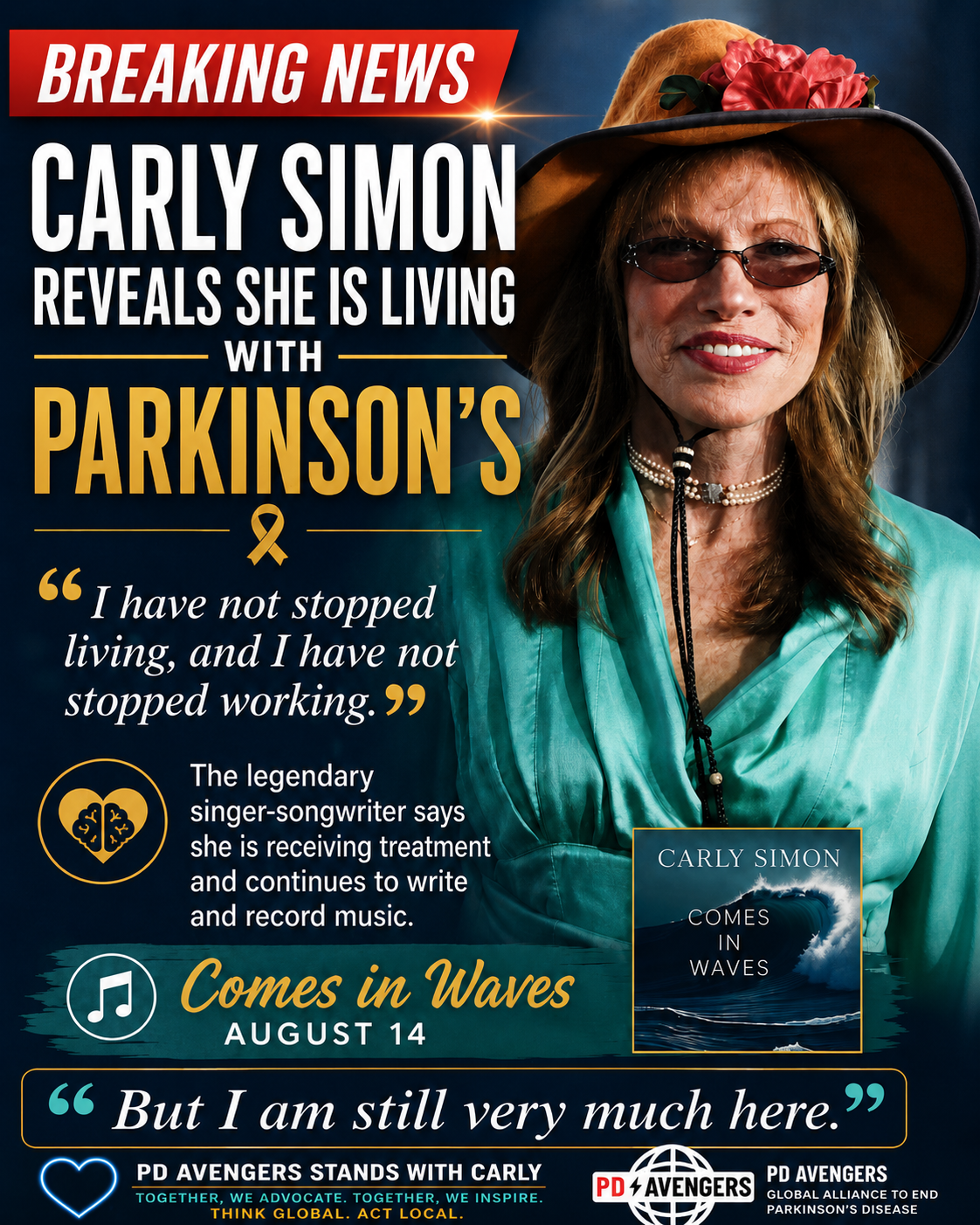
“I have not stopped living, and I have not stopped working.”
Her announcement comes as she prepares to release Comes in Waves, a new collection of original music scheduled for August 14, 2026. The album represents another chapter in a career defined by emotional honesty, sharp observation and songs that have endured for generations.
When joint problems became something more
Simon said her mobility problems initially appeared to be connected to arthritis in both knees and one hip. She underwent three joint-replacement operations, expecting the procedures to improve her ability to move.
The expected improvement did not come.
She began having difficulty standing from low chairs and deep couches without someone offering an arm. At times, she felt almost trapped after sitting down. Eventually, there were periods when she could not walk without considerable assistance.
Simon and her family realized that joint problems alone did not explain what was happening. Following an extensive assessment at the Mayo Clinic, she was diagnosed with Parkinson’s disease. She subsequently began treatment, including medication intended to reduce stiffness and address other symptoms.
Parkinson’s is commonly associated with tremor, stiffness, slowed movement and balance difficulties. However, it can also affect sleep, mood, cognition, energy, motivation, speech, digestion and many other aspects of daily life.
Simon’s account provides a particularly vivid illustration of that unpredictability. Some days, she said, exhaustion makes it difficult to get the day started. On other days, the disease gives her more room to move, think, work and feel like herself.
There is no dependable schedule. A more manageable day does not necessarily predict what tomorrow will bring.
The symptoms people may not see
Simon spoke openly about anxiety, depression, exhaustion and apathy—symptoms that may be less visible than changes in walking or movement but can be equally disruptive.
Her description of apathy is especially significant.
Apathy in Parkinson’s is not simply laziness, indifference or a failure to make an effort. It can diminish the internal drive required to begin an activity, even when the person understands that the activity matters and might normally enjoy it.
Simon compared the experience to lying like a starfish while nothing inside provides the instruction to get up, read, write, sing, call someone or otherwise participate in the day. She described it as though the part of the brain responsible for issuing invitations to engage with life had temporarily lost its guest list.
That distinction matters.
Friends and family may interpret inactivity as sadness, withdrawal or a lack of interest. The person experiencing apathy may be equally confused and frustrated. They may still care deeply about the people and activities around them but struggle to initiate action.
By describing this experience publicly, Simon is giving language to a symptom that many people with Parkinson’s and their families find difficult to explain.
A second health challenge
During the same period, Simon was diagnosed with basal cell carcinoma on her face. The cancer was successfully removed surgically, but the procedure affected her appearance and increased her reluctance to be photographed or seen publicly.
Simon acknowledged that she has long been highly critical of her appearance and recognized the irony for the writer of “You’re So Vain.” The surgery, she said, gave her internal critic additional material.
Her comments reveal another dimension of living with illness: the effect that treatment, physical changes and altered self-image can have on confidence and participation in public life.
Simon’s withdrawal was therefore not the result of one single issue. It reflected the combined effects of Parkinson’s, reduced mobility, fatigue, emotional symptoms, cancer treatment and concerns about her appearance.
Music gave shape to difficult days
Despite those challenges, Simon continued writing and recording.
Working privately at her Martha’s Vineyard home, she returned to melodies, lyrics and musical fragments that had accumulated over the years. Developing those ideas into a completed album gave structure to days that sometimes lacked it.
Music became a destination she could reach without leaving the room.
Simon said the process reminded her that illness can transform a person’s life without becoming the entirety of that life. The work offered focus, imagination and connection during a period marked by uncertainty and isolation.
The resulting album, Comes in Waves, is scheduled for release on August 14. Its first single, “Howl,” was released ahead of the album.
According to descriptions accompanying the project, the record returns to themes that have long shaped Simon’s songwriting, including love, memory, family, forgiveness, self-examination and the contradictions that can exist within intimate relationships.
A career built on emotional honesty
Carly Simon emerged as one of the defining singer-songwriters of the early 1970s. Her songs combined memorable melodies with intimate storytelling, sophisticated character studies and a willingness to explore vulnerability, relationships and the expectations placed on women.
Her best-known recordings include:
“You’re So Vain”
“Anticipation”
“Nobody Does It Better”
“Coming Around Again”
“The Right Thing to Do”
“Haven’t Got Time for the Pain”
“You Belong to Me”
“Let the River Run”
“Let the River Run,” written and performed for the film Working Girl, earned Simon an Academy Award, a Golden Globe and a Grammy. She was inducted into the Songwriters Hall of Fame in 1994 and the Rock & Roll Hall of Fame as a performer in 2022.
Her work has often drawn power from candour: the ability to articulate complicated feelings without resolving every contradiction. That same quality is present in the way she is now discussing Parkinson’s.
She does not romanticize the disease or describe it as a gift.
Instead, she calls it difficult, frustrating and sometimes frightening. She is learning to accept its presence without feeling that she has surrendered something essential about herself.
“But I am still very much here”
Simon expressed gratitude to her children, family, friends, caregivers and medical professionals. Their patience and support, she said, carried her through days when her own reserves were insufficient.
Her life now requires greater reliance on other people. She moves more slowly and recognizes that each day may be different from the last.
But dependence does not erase identity. Slower movement does not mean a person has stopped thinking, creating, loving or contributing.
Simon is still writing. She is still singing. She is still imagining, laughing, worrying and remembering. She can acknowledge the realities of Parkinson’s—including the occasional battle with an overstuffed chair—without allowing those realities to define everything she is.
Her final message is simple and forceful:
“But I am still very much here.”
Why Carly Simon’s disclosure matters
When a widely recognized public figure speaks openly about Parkinson’s, the value extends beyond greater awareness of the diagnosis itself.
Simon’s statement draws attention to several realities that are still frequently misunderstood:
Parkinson’s is more than a movement disorder. Its effects can include anxiety, depression, fatigue, apathy and cognitive or autonomic changes.
Symptoms can fluctuate. A person may function relatively well one day and require substantial support the next.
Apathy is a neurological symptom. It should not automatically be interpreted as laziness or a lack of caring.
Accepting help is not surrender. Needing assistance does not diminish a person’s intelligence, creativity, value or independence of thought.
Life continues after diagnosis. It may move at a different pace and require adaptation, but meaningful work, relationships and creativity remain possible.
Simon’s words will likely feel familiar to many people living with Parkinson’s, as well as care partners and family members trying to understand the disease’s less visible effects.
PD Avengers stands with Carly Simon
PD Avengers welcomes Carly Simon to a worldwide community that no one asks to join—but one filled with people determined to support one another, challenge stigma, advance research and demand better treatments.
Her decision to speak publicly takes courage. By sharing not only the diagnosis but also the fatigue, apathy, uncertainty and vulnerability surrounding it, she has helped make the full reality of Parkinson’s more visible.
We stand with Carly Simon, her family and every person affected by Parkinson’s.
We also stand with those who are newly diagnosed, those still searching for answers, those living with symptoms that others cannot see, and those providing care and support every day.
Carly Simon has not stopped living.
She has not stopped working.
She is still creating.
And she is still very much here.
