

Urgent Action Needed: Removing Barriers to Parkinson’s Treatments in Canada
The Honourable Marjorie Michel, P.C., M.P.
Minister of Health
House of Commons Ottawa,
Ontario K1A 0A6
Re: Urgent action needed to improve access to Parkinson's treatments and the clinical support required to deliver them
Dear Minister Michel, I am writing to ask for your leadership in addressing two urgent and interconnected challenges facing Canadians living with Parkinson's disease: delays in accessing newer treatments and barriers to receiving therapies that are already approved in Canada. Both issues have real consequences for people's independence, quality of life, and ability to participate in their families and communities.
I am a former broadcaster, an advocate, an activist and president and co-founder of the Global Alliance to End Parkinson's Disease DBA PD Avengers.
I am also one of more than 110,000 Canadians living with Parkinson's disease. I recognize the enormous demands facing Canada's healthcare system, including workforce shortages, rising costs, and competing priorities. However, for people living with a progressive neurological condition, delays in access to effective treatment are not simply administrative inconveniences. They can mean months or years of avoidable disability and lost independence.
Faster access to new Parkinson's treatments.
For decades, levodopa has been the foundation of Parkinson's treatment. It remains essential, but many people eventually experience increasingly unpredictable symptom control, periods when medication stops working effectively, and involuntary movements known as dyskinesia. Newer treatments offer important additional options, although none is a cure. Four therapies approved by the U.S. Food and Drug Administration warrant particular attention:

Juvmo (tavapadon): A once-daily treatment that acts directly on dopamine receptors and offers a different approach to managing Parkinson's symptoms.
Crexont (extended-release carbidopa/levodopa): Designed to provide longer-lasting symptom control and reduce the frequency of medication dosing.
Inbrija (inhaled levodopa): A treatment for intermittent OFF episodes that delivers levodopa through inhalation rather than the digestive system.
Rytary (extended-release carbidopa/levodopa): Another option for more sustained levodopa delivery and reducing fluctuations in symptom control.
These therapies will not be appropriate for everyone. However, treatment decisions should be made by patients and their healthcare professionals based on clinical need, not unnecessarily prolonged regulatory barriers.
Health Canada's Ministerial Reliance Order, which came into force in July 2026, provides an opportunity to make more efficient use of regulatory assessments already conducted by trusted foreign authorities.
I respectfully urge you to extend the eligible classes of medicines under this framework to include appropriate adult Parkinson's therapies, with the U.S. FDA identified as an eligible regulatory authority.
This would not require Canada to abandon its safety standards. It would allow Health Canada to avoid unnecessary duplication while retaining responsibility for Canadian-specific assessments.
Approval alone is not enough: the growing challenge of accessing advanced therapies
There is a second issue that deserves equally urgent attention.
Canada has already approved innovative treatments that can provide meaningful improvement in symptom control for appropriately selected people with advanced Parkinson's.
One example is Vyalev (foslevodopa/foscarbidopa), which delivers medication continuously through a small pump and a subcutaneous infusion.
Clinical research has demonstrated that this approach can increase daily time with good symptom control and reduce troublesome motor fluctuations compared with conventional oral treatment.
Unlike intestinal infusion treatments, Vyalev does not require surgery to place a feeding tube. Nevertheless, patients need appropriate training, clinical oversight, dose adjustment, troubleshooting, and ongoing support.
This is where significant concerns about access arise.
We are hearing from Canadians with Parkinson's and clinical workers that there are concerns that the nursing time and specialized support required to initiate and manage infusion therapies may be limiting access for patients who could benefit.
If medically appropriate treatments are being delayed or declined because clinical teams lack the resources to support them, that represents a serious gap in our healthcare system.
We cannot allow a lack of implementation capacity to become a substitute for a clinical decision.
There is already a Canadian model worth examining.
Patients receiving Duodopa, an intestinal levodopa infusion therapy, may receive support through movement-disorder clinics, specialized nursing teams, and manufacturer-linked patient-support services.
These professionals play an essential role in helping patients and care partners learn to manage the treatment, identify complications, and maintain continuity of care.
Vyalev also has a manufacturer-linked patient-support program. However, we need to establish whether comparable, dependable clinical nursing support is available to every eligible patient, regardless of their province, community, or treating clinic.
If these support structures exist for one advanced therapy, why are patients reporting barriers to obtaining the nursing support needed for another?
And if the issue is insufficient nursing capacity, why are we allowing that shortage to determine whether someone receives an otherwise appropriate treatment?
These are questions that deserve clear answers.
A shared federal and provincial responsibility
I recognize that medication reimbursement, nursing services, and the delivery of healthcare fall substantially within provincial and territorial jurisdiction.
That does not mean the federal government is without a role.
Health Canada regulates medicines, while federal, provincial, and territorial governments share responsibility for improving access to healthcare. This is an opportunity for national leadership and coordination.
I urge your government to work with provincial and territorial health ministries, movement-disorder specialists, nurses, manufacturers, and patient organizations to identify and address the barriers preventing appropriate access to advanced Parkinson's treatments.
Possible solutions include dedicated Parkinson's nurse specialists, standardized training pathways, regional infusion-support services, and clear agreements defining the responsibilities of specialty clinics and manufacturer-supported nursing programs.
We should also examine the full cost of delaying treatment, including preventable hospitalizations, falls, emergency visits, increased reliance on care partners, and earlier admission to long-term care.
The cost of providing nursing support must be considered alongside the potential cost of withholding or delaying effective treatment.
Our requests
I respectfully ask you to take the following actions:
Expand the Ministerial Reliance Order's eligible drug classes to include appropriate adult Parkinson's therapies, using assessments by trusted foreign regulators where doing so meets Canada's safety requirements.
Engage manufacturers of FDA-approved Parkinson's treatments to encourage Canadian submissions and identify opportunities to shorten unnecessary regulatory delays.
Clarify interim access pathways for Canadians whose physicians prescribe treatments that are authorized in the United States but not yet approved in Canada, including the applicable rules for personal importation and Health Canada's Special Access Program.
Convene federal, provincial, and territorial discussions about the barriers to advanced Parkinson's therapies, with particular attention to nursing capacity, specialized clinical support, and regional disparities.
Examine the delivery models for Duodopa and Vyalev, including manufacturer-supported services, and determine what additional investment or coordination is needed to provide equitable access to appropriate clinical nursing care.
Provide a written response within 30 days, outlining the actions Health Canada can take, the discussions it will initiate with provincial and territorial partners, and anticipated timelines.
The urgency is real
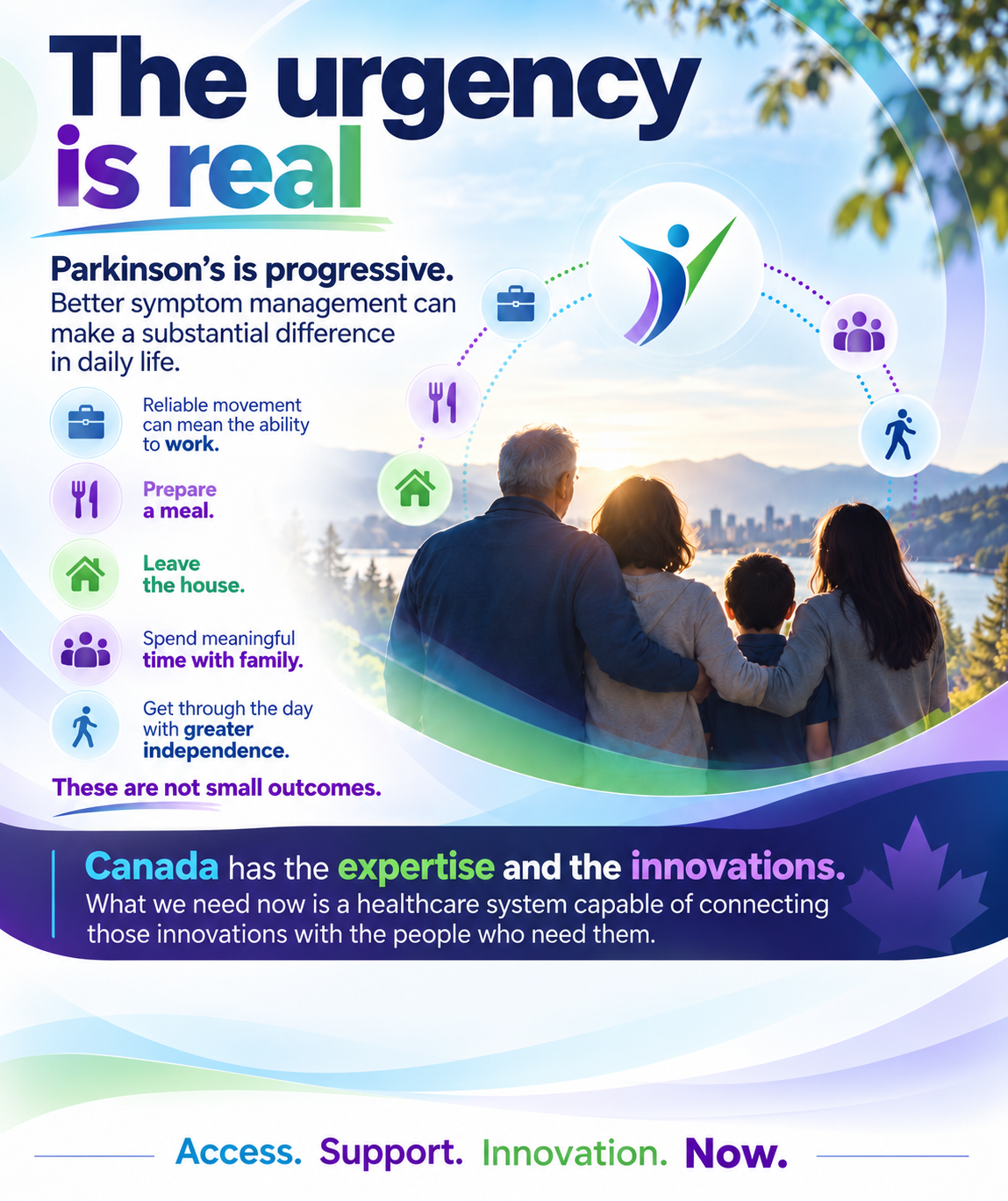
Parkinson's is progressive. While these treatments do not stop the underlying disease, better symptom management can make a substantial difference in a person's daily life.
For someone living with Parkinson's, additional time with reliable movement may mean the ability to work, prepare a meal, leave the house, spend meaningful time with family, or simply get through the day with greater independence.
These are not small outcomes.
Canada has highly skilled neurologists, movement-disorder specialists, nurses, researchers, and patient advocates. We also have access to an expanding range of treatment innovations.
What we need now is a healthcare system capable of connecting those innovations with the people who need them.
A treatment that is approved but cannot be accessed is a missed opportunity. A treatment that is available but cannot be supported is an incomplete promise.
Minister Michel, I am asking for your leadership in ensuring that Canadians living with Parkinson's are not left waiting unnecessarily for either the treatments or the clinical care that can improve their lives.
I would welcome the opportunity to meet with you and your officials to discuss practical solutions.
Thank you for your consideration. I look forward to your response.
Sincerely,
Larry
Larry Gifford
President, PD Avengers
cc: Shalene Curtis-Micallef, Deputy Minister of Health Honourable
Ravi Kahlon, Minister of Health
Karen Lee, CEO Parkinson Canada
JoAnne Baker, CEO Parkinson Society of British Columbia
Margot M. Micallef, K.C.
PD Avengers Board of Directors
